
May 7, 2026
Each year, hundreds of thousands of workers are injured on the job or become sick with work-related illnesses right across the country. Yet when these same workers need to access vital supports, far too many are left without an income. Approximately one in four workers do not qualify for WSIB – this translates to 1.56 million Ontario workers who would not be able to access crucial income replacement, healthcare coverage or return-to-work supports.
Workers need safer workplaces and each day, unions are fighting hard to ensure that workers go to work and come home in the same shape. When they do not, it is critical that they and their families have the supports they need to recover and not face worsening hardship.
Workplace injuries are a political and equity issue for the labour movement. Workers are far too often treated as disposable, particularly workers from newcomer communities, Indigenous and Workers of Colour. Black, Indigenous, Workers of Colour and workers with disabilities are far more likely to end up in lower paid, more precarious jobs without union protection and with a higher rate of injury. Employers and governments must not be benefiting from the injuries of working people. It is bad enough to be injured on the job, workers must not have the double or triple burden of navigating a complicated system without just compensation.
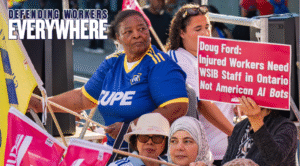
CUPE Local 1750 representing workers at WSIB are launching a campaign to restore fairness to workers, when it comes to workers’ compensation.
The Labour Council resolves to recommend that affiliates push the government to:
- Use the existing WSIB surplus for benefit and service improvements, not more refunds to
employers. Ontario employers have gained $21.5 billion in cumulative cost reductions and direct
refunds since 2017 – while workers have been made to wait and suffer. - Expand coverage for all workers – this includes to the 1.56 million workers who currently are not
covered by WSIB. - Restore the loss of earnings from 85% to 90% retroactively with no earnings cap.
- Eliminate age discrimination at the WSIB by ending the Loss of Earnings (LOE) cut-off at age 65.
With this cost of living crisis and the decline of defined benefit pension plans, many workers
currently have to work beyond 65 and they should not bear the complicated burden of proof to show
they fully intended to work beyond age 65. - Improve services for Ontario workers – which includes increasing staff to levels that would reduce
systemic workload issues. - Restore funding for Ontario’s health and safety associations to prevent injuries, illness and fatalities.
Prevention is always the best choice: according to a study completed by the Institute for Work &
Health (IWH). Every $1 invested in prevention yields a return on investment of $1.24 to $2.14.